before May 1
Long Walk selection and drawing
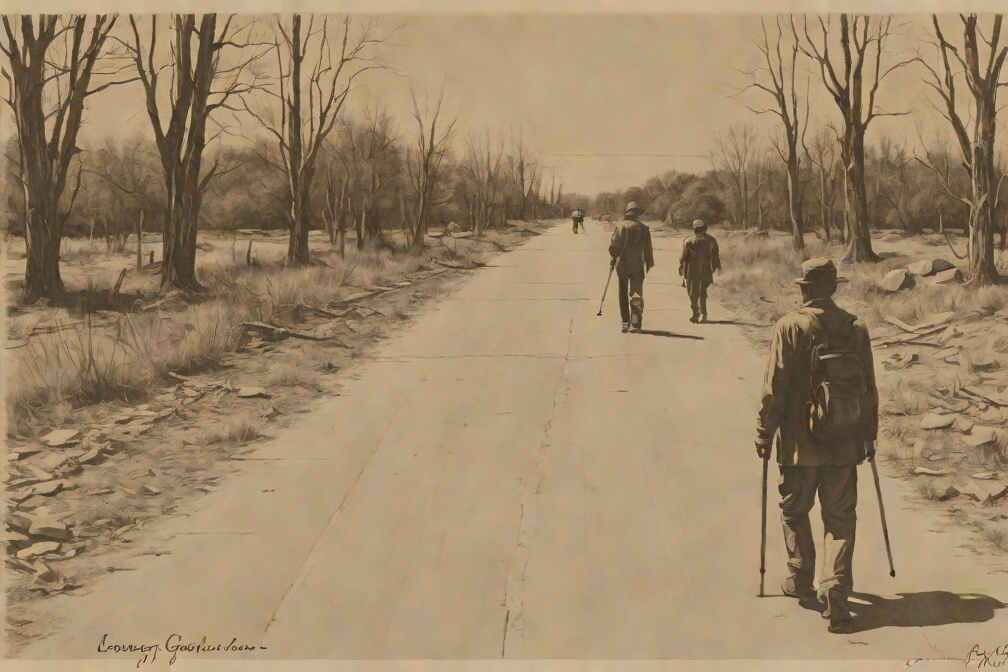
[Ray Garraty](entity:character-recall-character-ray-garraty-318b948e20ef) is selected as a [Prime Walker](entity:state-recall-state-prime-walker-5ff8d7d22ddb) after the televised [Long Walk selection and drawing](entity:event-recall-event-long-walk-selection-and-68e3655d2459). The State turns participation into a public honor, while the possibility of withdrawal narrows through the [April 15th backout date](entity:time-recall-time-april-15th-backout-date-ec8cd1e9592e) and the later [April 31st backout date](entity:time-recall-time-april-31st-backout-date-a53f5ddd0932). Garraty’s mother, [Jan](entity:character-recall-character-jan-7e299a0a9728), and [Dr. Patterson](entity:character-recall-character-dr-patterson-5f84d376d4b4) urge him to withdraw, but pride, expectation, and the promise of the [Prize](entity:concept-recall-concept-prize-672d5d83d14a) keep him committed.
[Peter McVries](entity:character-recall-character-peter-mcvries-9d51cc3c307b), by contrast, is summoned only after a [Backup Walker](entity:state-recall-state-backup-walker-8d4e558e722c) withdraws. His forced last-minute entry reveals how the system converts hesitation into consent and how little freedom the participants retain once they are chosen.
May 1 at 2:00 AM
Departure for Pownal
Garraty leaves for [Pownal](entity:location-recall-location-pownal-1b7e099153cd) with his mother in an old blue Ford. She pleads with him to change his mind, but the withdrawal deadline has passed, and Garraty insists that taking part was his own decision. He carries her cookies as a small token of home.
The journey establishes the emotional cost beneath the spectacle: Garraty wants independence and glory, yet he is already abandoning the people who love him. His mother’s fear contrasts sharply with the State’s impersonal machinery.
May 1 at 8:00 AM
The American–Canadian border
At the guarded starting area near the American–Canadian border, Garraty surrenders his identification card to a computer terminal and watches the State confirm his identity. The rural setting is crowded with soldiers, cars, equipment, and other sixteen- and seventeen-year-old participants.
Garraty meets [Peter McVries](entity:character-recall-character-peter-mcvries-9d51cc3c307b), then joins [Arthur Baker](entity:character-recall-character-arthur-baker-5ccb2b0e6e33) and [Hank Olson](entity:character-recall-character-hank-olson-281eb3944c33). The boys exchange nervous jokes and speculate about the Walk, forming the first fragile social circles that will later become lifelines and liabilities.
May 1 at 8:16 AM
The Major’s opening ritual
[The Major](entity:character-recall-character-the-major-daf8a4357d5f) arrives with a jeep and a halftrack, gives the boys a brief instruction to conserve energy, and distributes numbered identifiers. Garraty is fascinated by the Major’s authority and physical presence, even though his father [Jim Garraty](entity:character-recall-character-jim-garraty-fbd2d8bd3757) had condemned him as a State-supported sociopath.
The ritual turns the boys into numbered units while preserving the language of honor, valor, and sport. Garraty receives number 47, McVries number 61, Olson number 70, and [Stebbins](entity:character-recall-character-stebbins-517155ad600f) number 88.
May 1 at 9:00 AM
The Walk begins
The hundred Walkers cross the starting marker and begin moving at the enforced minimum of four miles per hour. Garraty feels relief that he has not frozen, while the halftrack’s radar and computer system immediately begin monitoring every step.
The rules become physically real almost at once. A warning is issued to [Stebbins](entity:character-recall-character-stebbins-517155ad600f), who deliberately tests the boundary and demonstrates that warnings can be shed only by continuing to walk for hours.
May 1 shortly after 9:00 AM
Barkovitch’s first warning gamble
[Gary Barkovitch](entity:character-recall-character-gary-barkovitch-881673718e10) stops to remove a stone from his shoe and accepts three warnings in rapid succession. He then rejoins the Walk, boasting that the maneuver is part of his Plan and that he has bought himself a brief rest.
The incident exposes the cruel arithmetic of the [Warning system](entity:concept-recall-concept-warning-system-2fe6dc28c9e3): a moment of relief creates hours of heightened danger. Barkovitch’s need to dominate the others through calculation also begins his isolation from the group.
May 1 at about 9:13 AM
The first-mile announcement
[The Major](entity:character-recall-character-the-major-daf8a4357d5f) announces that the Walkers have completed one mile and reminds them that the record for a full complement is only seven and three-quarter miles. The information shocks Garraty because the distance is far shorter than he imagined.
The announcement reframes the event as a record-breaking public contest while quietly revealing how routinely the State expects mass death. The boys are not simply traveling; they are competing against an archive of previous collapses.
May 1 around 10:00 AM
Garraty’s first public kiss
A girl holding a GO-GO-GARRATY sign rushes from the crowd and kisses Garraty. He responds passionately, touches her, and then receives a warning for leaving the pace. The encounter briefly fills him with confidence and sexual excitement.
The moment shows how the spectators turn the Walk into intimate entertainment. Garraty feels both flattered and ashamed, while his friends tease him and McVries reminds him not to waste energy.
May 1 shortly after 11:00 AM
Curley’s death
[Curley](entity:character-recall-character-curley-65660fc097b0) develops a charley horse, falls behind, and accumulates warnings while trying desperately to keep walking. Despite insisting that his injury is unfair, he cannot regain the required speed. The soldiers shoot him beside the road as the other Walkers and spectators watch.
[Curley’s death](entity:event-recall-event-curley-s-death-35cc9f3c59b3) destroys the boys’ remaining distance from the reality of the event. Garraty is horrified by the blood and brains, yet he also recognizes the primitive relief of seeing someone else eliminated before him.
May 1 around noon
Arrival in Limestone
The Walkers enter [Limestone](entity:location-recall-location-limestone-68b86724c9a2) after surpassing the previous full-group distance record. Garraty eats his mother’s cookies while spectators cheer, and the town’s modest streets become a temporary theater of local pride.
The celebration is already contaminated by the knowledge that [Curley](entity:character-recall-character-curley-65660fc097b0) is missing from it. The Walk demonstrates how quickly public ceremony absorbs death and continues as if the dead were merely part of the route.
May 1 around 2:00 PM
Ewing’s blister crisis
[Ewing](entity:character-recall-character-ewing-e79aa6af8062), a strong Walker from Texas, develops severe blisters after wearing sneakers, violating the practical advice in the [Hints](entity:concept-recall-concept-hints-5b6ca7e994a7). His feet become infected and swollen, yet the [Warning system](entity:concept-recall-concept-warning-system-2fe6dc28c9e3) allows no accommodation for injury.
[Gary Barkovitch](entity:character-recall-character-gary-barkovitch-881673718e10) responds with racist abuse, prompting [Arthur Baker](entity:character-recall-character-arthur-baker-5ccb2b0e6e33) to threaten him. The episode makes clear that physical strength cannot protect anyone from a small error, and that the Walk magnifies prejudice as well as pain.
May 1 around 2:30 PM
Ewing’s death
[Ewing](entity:character-recall-character-ewing-e79aa6af8062) falls below the required pace while surrounded by other boys. Soldiers separate him from the group and shoot him at close range despite his attempts to resist. The Walkers continue, stunned by the efficiency of the killing.
[Peter McVries](entity:character-recall-character-peter-mcvries-9d51cc3c307b) observes that Ewing bleeds the same color as anyone else. His remark punctures the State’s abstraction of numbers and returns the event to the physical fact of a boy’s body being destroyed.
May 1 at 3:00 PM
First rainstorm
A violent thunderstorm breaks over the Walk. The boys are soaked, and the sudden cold and wind add another layer of suffering to their already exhausted bodies. Garraty briefly feels exhilarated by the rain, while others begin to show fatigue.
The storm erases the distinction between spectacle and ordeal. The soldiers remain impassive, and the Walk continues without pause, demonstrating that weather, injury, and terror matter only insofar as they affect speed.
May 1 late afternoon
Unnamed Walker’s death
A nameless boy slows repeatedly during the rain and is shot. Garraty steps around the body without learning the boy’s identity, realizing that some deaths disappear even from the collective memory of the Walkers.
The death deepens the novel’s criticism of bureaucratic violence: the boy is not granted a story, only a penalty for failing to maintain a number on a monitor.
May 1 at about 4:30 PM
Zuck’s death
[Zuck](entity:character-recall-character-zuck-c4852516f158) has been bleeding from a knee wound since falling on the railroad tracks. When his warnings accumulate, he suddenly breaks into a desperate run, silhouetted against the red sunset as he tries to escape the halftrack.
The soldiers pursue him and fire after he disappears over a rise. His effort is both futile and strangely heroic: he transforms the enforced walk into a last, instinctive attempt to outrun the system.
May 1 around 5:45 PM
Travin’s death
Travin develops severe diarrhea and struggles to keep his trousers up while walking. Each attempt to relieve himself costs him warnings, and the soldiers shoot him when he can no longer maintain the pace.
The incident strips away every remaining idealization of the contest. Bodies must perform public functions under surveillance, and ordinary human vulnerability becomes grounds for execution.
May 1 around 6:00 PM
The graveyard argument
As the Walkers pass a misty graveyard, McVries jokes about death and provokes Olson, who is already frightened and exhausted. Baker tells McVries to leave Olson alone, while Garraty recognizes that the group’s humor is becoming a defense against terror.
The argument reveals the widening gap between the boys’ strategies for surviving psychologically. Olson retreats into prayer and denial, whereas McVries uses cruelty and performance to keep himself from collapsing.
May 1 around 7:45 PM
Fenter’s death
Fenter develops a stiff foot and receives his final warning. Garraty sees a St. Christopher medal in his hand shortly before the soldiers shoot him.
Fenter’s death arrives amid the Walkers’ exhausted discussion of love, sex, money, and the [Prize](entity:concept-recall-concept-prize-672d5d83d14a). The medal becomes an emblem of protection that cannot protect him, while the group’s conversation reveals how quickly faith and romance are reduced to survival talk.
May 1 around 9:00 PM
The steep-grade deaths
The Walkers confront a long, steep hill. Larson sits down to rest and is shot after failing to rise, while several others die in the darkness, including a boy from the vanguard. The climb turns the road into a physical trap.
Garraty becomes dizzy and fears that his own body will fail. The hill teaches him that endurance is not a fixed physical quality but a temporary arrangement between will, fear, and exhausted muscle.
May 1 around 9:00 PM
Stebbins’s account of the finish
[Stebbins](entity:character-recall-character-stebbins-517155ad600f) tells Garraty and McVries about witnessing the end of a previous Long Walk as a child. He describes the final two Walkers as mutilated, barely human figures who continue past a massive crowd until one collapses and the other is declared the winner.
The story replaces the abstract idea of victory with an image of exhaustion, public worship, and intimacy between the last two survivors. It also makes Stebbins appear unnervingly informed and emotionally detached.
May 1–2 overnight
The first night’s collapse
During the first night, more Walkers die from exhaustion, convulsions, slowing down, and failed attempts to escape. Garraty drifts through memories of his mother, [Jan](entity:character-recall-character-jan-7e299a0a9728), childhood shame, and his first experiences of sex and guilt.
The darkness becomes a psychological landscape in which past and present merge. Garraty discovers that memory can briefly shelter him, but it also exposes the life he is forfeiting with every step.
May 2 around 5:00 AM
McVries’s assault on the halftrack
McVries suddenly erupts at the soldiers, shouting insults and running toward the halftrack. He refuses to stop until Garraty physically shoves him away, preventing an almost certain shooting. Both boys receive warnings.
The incident reveals the rage beneath McVries’s sardonic humor and forces Garraty to risk his own survival for him. Their relationship becomes more intimate, but also more dangerous, because each rescue creates a debt the Walk may eventually demand.
May 2 at 5:30 AM
The Major’s second review
[The Major](entity:character-recall-character-the-major-daf8a4357d5f) passes the Walkers in his jeep, and many of them cheer despite their resentment. McVries, [Collie Parker](entity:character-recall-character-collie-parker-0bfbcb537d23), and [Gary Barkovitch](entity:character-recall-character-gary-barkovitch-881673718e10) refuse to participate, while Garraty feels ashamed after joining the salute.
The scene shows how the State’s ritual authority survives even after the boys understand its violence. Pride, habit, and the crowd’s expectations keep them performing loyalty to the man directing their deaths.
May 2 around 6:00 AM
Harkness’s book collapses
[Harkness](entity:character-recall-character-harkness-1235ab4fdd67), who has been recording names for a future book, develops a severe foot cramp. He removes a shoe and limps onward, but barely survives the [Warning system](entity:concept-recall-concept-warning-system-2fe6dc28c9e3) as the soldiers repeatedly aim at him.
He eventually recovers enough to continue, yet the episode demonstrates how quickly intellectual ambition becomes irrelevant. His proposed record of the Walk is itself threatened by the physical conditions he hoped to document.
May 2 morning
Scramm’s family hope
Garraty learns that [Scramm](entity:character-recall-character-scramm-73f1fb1be6e3) is married to [Cathy Scramm](entity:character-recall-character-cathy-scramm-519573b2adf1) and that she is pregnant. Scramm believes he can win and intends to secure a future in which their child attends college, treating the Walk as an adventure rather than a death sentence.
His optimism gives the remaining boys a vision of ordinary life beyond the road. It also makes his vulnerability more painful, because the future he describes depends on a victory the Walk is designed to deny.
May 2 around 6:45 AM
Gribble’s death
[Gribble](entity:character-recall-character-gribble-7a796eeb8217) breaks from the Walk to embrace a young woman at the roadside. He receives warnings while kissing her, then struggles back to the road, overwhelmed by frustration and physical pain. He collapses and is shot.
The episode turns sexual desire into another form of fatality. The crowd receives the encounter as entertainment, while Garraty sees the terrible conflict between the body’s urgent wants and the Walk’s demand for mechanical obedience.
May 2 around 7:00 AM
Harkness’s death
After surviving his first foot crisis, [Harkness](entity:character-recall-character-harkness-1235ab4fdd67) ultimately falls behind and is shot. The group hears the gunfire and understands that his planned book will never exist.
His death breaks another piece of the social circle around Garraty. The boys’ conversations, jokes, and imagined futures are steadily erased, leaving only the road and the shrinking number of survivors.
May 2 around 8:00 AM
Percy’s escape attempt
[Percy](entity:character-recall-character-percy-bd71a2c8af9f) edges toward the woods while the other Walkers debate whether he has the courage to leave. The soldiers have been watching him all along, and they shoot him the moment he crosses the verge.
Percy’s death shows that escape is not a neglected possibility but an illusion permitted only until the system chooses to close its hand. His mother’s repeated attempts to reach him become one of the Walk’s most painful human echoes.
May 2 around 9:30 AM
The Century Club hysterical episode
At the hundred-mile celebration, a vast crowd surrounds the Walkers with signs, cameras, confetti, and cheers. Garraty begins laughing uncontrollably at the spectacle, collapses to his knees, and receives warnings while McVries drags him back into motion.
The laughter is a psychological rupture caused by the collision of public celebration and mass death. McVries saves Garraty again, converting their friendship into a bond that neither can acknowledge without also acknowledging its cost.
May 2 at 2:30 PM
The Dom L’Antio watermelon incident
Dom L’Antio offers the Walkers ice-cold watermelon, provoking several boys to break from the route. State Troopers intervene, and Dom throws the slices toward the Walkers before being tackled and arrested. Garraty, [Abraham](entity:character-recall-character-abraham-d114b192c3c3), [Collie Parker](entity:character-recall-character-collie-parker-0bfbcb537d23), and McVries manage to eat pieces of the fruit.
The incident becomes a rare collective victory against the rules. The watermelon briefly restores pleasure, solidarity, and humor, though [Stebbins](entity:character-recall-character-stebbins-517155ad600f) refuses the gift and remains untouched by the group’s momentary joy.
May 2 from 2:30 to 4:00 PM
The second storm
A violent storm approaches after the watermelon incident, bringing wind, hail, rain, and plunging temperatures. [Jensen](entity:character-recall-character-jensen-cce402b00b2d) panics and runs off the road, where the soldiers shoot him. The remaining boys struggle through the weather while the crowd seeks shelter.
The storm destroys the fantasy that the Walk is controlled entirely by human rules. Nature becomes another indifferent force, and the boys’ survival depends on enduring both the State’s machinery and the world’s instability.
May 2 around midnight
Oldtown arrival
The Walkers enter [Oldtown](entity:location-recall-location-oldtown-909d382b43db) amid confetti, lights, streamers, fireworks, and a huge crowd. The town is transformed into a noisy public festival, then quickly recedes as the group follows the [Stillwater River](entity:location-recall-location-stillwater-river-b5fe07c768d3) toward the turnpike.
Oldtown marks the transition from remote roads to the State’s largest continuous spectacle. The crowd becomes more organized and more frightening, while the Walkers are increasingly treated as public property.
May 3 shortly after midnight
The Oldtown turnpike salute
At the entrance to the turnpike, a color guard fires a four-hundred-gun salute under the Major’s command. McVries organizes a return salute from the Walkers, but their collective raspberry is weak and quickly abandoned.
The exchange exposes the asymmetry between State power and individual resistance. Even the boys’ mockery is absorbed into the spectacle, becoming another scheduled performance for the crowd.
May 3 early morning
The turnpike march
The remaining Walkers enter the turnpike, where crowds line the broad road and the route becomes flatter but more monotonous. Garraty walks along the median until planted pines and the rules force him back onto the pavement.
The turnpike offers no relief despite its apparent smoothness. Its engineered openness becomes another form of confinement, with the spectators and halftracks enclosing the boys from every side.
May 3 around 1:00 AM
Garraty’s public humiliation
Garraty’s bowels force him to stop in the glare of the turnpike while spectators point, laugh, and photograph him. He barely avoids elimination and later jokes with McVries about having forgotten toilet paper.
The scene strips away the last boundary between private life and public entertainment. Garraty survives, but the experience makes him understand that the crowd will consume every bodily humiliation as eagerly as every death.
May 3 early morning
Mike’s death
[Mike](entity:character-recall-character-mike-cb6fa8ab1468), one of the Hopi brothers who have led the Walk, develops severe cramps. He and [Joe](entity:character-recall-character-joe-9b197d8c56ff) continue as long as they can, but Mike eventually falls and is shot, leaving Joe alone.
The brothers’ separation intensifies the Walk’s destruction of family bonds. Their presence had suggested a shared cultural and familial strength, but the event permits no collective survival.
May 3 morning
McVries explains Priscilla
McVries recounts his relationship with [Priscilla](entity:character-recall-character-priscilla-4c0f8c1856b2), including their work at the [Plymouth Sleepwear factory](entity:location-recall-location-plymouth-sleepwear-f-c97e5f1ba59a), their growing conflict over money, and the confrontation in which she cut his face with a letter opener. He admits that the romance had become an excuse rather than a complete explanation for joining the Walk.
The confession gives emotional history to his scar and reveals his self-destructive need to turn humiliation into punishment. His rejection by Priscilla echoes the Walk’s larger demand that personal identity be reduced to endurance.
May 3 around 10:30 AM
The Scramm–Mike defiance
[Scramm](entity:character-recall-character-scramm-73f1fb1be6e3), feverish with pneumonia, realizes that he is dying. He joins [Mike](entity:character-recall-character-mike-cb6fa8ab1468), and the two men deliberately turn toward the crowd, insult the soldiers, then sit down together and wait for the execution.
Their defiance gives Scramm control over the manner of his ending and allows Mike to die beside him. The scene becomes a final gesture of companionship against a system that insists every death be solitary and useful only as spectacle.
May 3 afternoon
The no-help pact
As the remaining Walkers weaken, [Abraham](entity:character-recall-character-abraham-d114b192c3c3) proposes that they stop helping one another. Garraty agrees, despite knowing that the pact contradicts the friendship formed among them, and the others gradually accept it as well.
The pact marks a decisive moral collapse. Survival now requires treating companions as competitors, and the boys transform the State’s cruelty into a rule they enforce upon themselves.
May 3 late afternoon
The approaching Freeport reunion
The Walkers approach [Freeport](entity:location-recall-location-freeport-f3bdf24c2bb7), Garraty’s home region, while he anticipates seeing [Jan](entity:character-recall-character-jan-7e299a0a9728) and his mother. His excitement turns to panic as he imagines missing them in the crowd or discovering that they are absent.
Freeport becomes less a destination than a test of whether personal love can survive the rules of the Walk. Garraty’s desire to reach his family threatens to make him violate the very conditions keeping him alive.
May 3 around 6:00 PM
Collie Parker’s assault on the soldiers
[Collie Parker](entity:character-recall-character-collie-parker-0bfbcb537d23) suddenly climbs onto the halftrack, kills one soldier, seizes a rifle, and calls on the other Walkers to join him. The remaining soldiers shoot him in the back before the group can respond.
Parker’s attack exposes a fleeting possibility of collective rebellion that the Walkers are too exhausted and conditioned to seize. McVries recognizes that they might have succeeded, but the chance vanishes with Parker’s body.
May 3 evening
Baker’s mental collapse
[Arthur Baker](entity:character-recall-character-arthur-baker-5ccb2b0e6e33) becomes increasingly obsessed with death, funerals, and the lead-lined coffin he wants if Garraty wins. He speaks as though he has already entered the grave and confesses that he may have joined the Walk because he wanted to die.
Baker’s delusion transforms his earlier warmth into a vision of death as shelter. Garraty recognizes the danger but cannot save him because of the no-help pact and because Baker himself has begun to move beyond rescue.
May 4 around 2:20 AM
Baker’s death
Baker falls and strikes his head during the rain. Garraty instinctively tries to help, but McVries stops him and reminds him of the pact. Baker eventually rises, walks past them in a brief return of sanity, and asks Garraty to arrange a lead-lined coffin if he wins and not to watch the execution.
Garraty promises, then hears the shots despite covering his face. [Baker’s death](entity:event-recall-event-baker-s-death-e8c8486c2475) ends one of the original friendships and leaves Garraty with a final obligation that he may never be able to fulfill.
May 4 around 2:00 AM
The Massachusetts crossing
The surviving Walkers cross from [New Hampshire](entity:location-recall-location-new-hampshire-5211f8695ec5) into [Massachusetts](entity:location-recall-location-massachusetts-3b184ac6dfe9) amid fireworks, cannons, bands, and a crowd stretching as far as Garraty can see. The crossing is treated as a historic achievement because so few Long Walks have reached this far.
The triumph is grotesque: the boys are celebrated precisely as they approach the limits of bodily survival. The State turns geographic progress into another layer of coercive prestige.
May 4 morning
Stebbins’s revelation
[Stebbins](entity:character-recall-character-stebbins-517155ad600f) reveals that he is the Major’s bastard son. He entered the Walk intending to win and demand admission into his father’s household, believing that the [Prize](entity:concept-recall-concept-prize-672d5d83d14a) would force the Major to acknowledge him. Instead, the Major deliberately made him the Rabbit, a lure to drive the other Walkers farther.
The revelation explains Stebbins’s knowledge, confidence, and isolation. His apparent invulnerability is exposed as another role assigned by the State, and the Rabbit metaphor becomes a diagnosis of the entire contest.
May 4 around 10:30 AM
Fielder’s death
When the road narrows between hills packed with spectators, [George Fielder](entity:character-recall-character-george-fielder-dc69dd213050) panics and screams that the crowd will eat the Walkers. He spins, collapses, and is shot while the crowd’s roar overwhelms the sound of the rifles.
Fielder’s fear gives literal form to the spectators’ hunger. [The Crowd](entity:concept-recall-concept-the-crowd-70b3f1643a99) is no longer merely an audience but an active consuming force that turns the boys’ deaths into communal appetite.
May 4 late morning
Hough and Milligan’s deaths
[Bill Hough](entity:character-recall-character-bill-hough-dbfd86c58df1) dies around quarter to eleven, followed by [Milligan](entity:character-recall-character-milligan-07b56c6dbd41) at approximately eleven-thirty. Their deaths come with little ceremony as the Walk continues through rain and public celebration.
The sequence shows how quickly individual identity disappears near the end. Names still circulate among the survivors, but the bodies are becoming interchangeable markers of distance and attrition.
May 4 late morning
Baker’s final request remembered
After [Baker’s death](entity:event-recall-event-baker-s-death-e8c8486c2475), Garraty continues to carry his request for a lead-lined coffin. The promise becomes part of Garraty’s private burden as the Walk reduces him to fewer and fewer relationships.
The obligation matters because it preserves a fragment of moral life inside the no-help pact. Even while Garraty competes to survive, he remains tethered to the needs of the dead.
May 4 evening
McVries’s final surrender
With only Garraty, McVries, and [Stebbins](entity:character-recall-character-stebbins-517155ad600f) remaining, McVries falls asleep while walking and admits that he has reached the point where he must sit down. Garraty tries to stop him, but McVries calmly sits cross-legged on the road like a monk.
The soldiers drag McVries away despite Garraty’s pleas to shoot him instead. McVries’s surrender fulfills his earlier prediction that the will would eventually run out, and it leaves Garraty emotionally empty but newly determined to defeat Stebbins.
May 4 around 8:00 PM
Stebbins’s death
[Stebbins](entity:character-recall-character-stebbins-517155ad600f), weakened at last, reaches for Garraty’s shirt in a final desperate attempt to be rescued and collapses. Garraty confirms that he is dead, but the revelation barely registers before the crowd and the Major reclaim the road.
[Stebbins’s death](entity:event-recall-event-stebbins-s-death-c1902ce66f28) completes the Rabbit’s failure. [The Major](entity:character-recall-character-the-major-daf8a4357d5f)’s instrument has been reduced to flesh and blood, and Garraty is left as the sole surviving Walker, though victory feels indistinguishable from mental collapse.
near the ending
The end of the Long Walk
[The Major](entity:character-recall-character-the-major-daf8a4357d5f) approaches Garraty in his jeep and prepares to declare him the winner and grant the [Prize](entity:concept-recall-concept-prize-672d5d83d14a). Behind him, soldiers shoot [Stebbins](entity:character-recall-character-stebbins-517155ad600f)’s already-dead body, preserving the ritual even after the contest has effectively ended.
Garraty does not respond as a triumphant survivor. He sees a dark figure beckoning farther down the road, shakes off the Major’s hand, and begins to run toward it, convinced that the Walk is not truly over.
final moment
The unfinished victory
Garraty runs toward the mysterious dark figure while the crowd chants his name and the Major waits behind him. The figure may represent another dead Walker, death itself, or the endless continuation of the road, but Garraty recognizes it only as something calling him onward.
The novel ends without a stable victory, material reward, or psychological return home. The State may have produced its winner, yet Garraty’s mind has been absorbed by the Walk, leaving the final movement suspended between survival and annihilation.